

Understanding Articulated 3D Prints
In this guide
- Movement can come from shape rather than soft plastic
- What “print-in-place” means—and what it does not
- A practical comparison: dragon and skeleton dinosaur
- Four questions to ask before choosing
- A gentle first-use check
- Read surface texture separately from damage
- Ask before changing size or adding a name
- Keep the model enjoyable by keeping its limits clear
A dragon that curls across a desk and a skeleton dinosaur with moving sections can both be described as articulated, but that word does not mean the whole object is flexible. Understanding where the movement comes from helps you choose a model, handle it sensibly and spot a problem without forcing it.
This is an explanation of common filament-print design ideas, with catalog examples for context. It is not a report of laboratory testing, an age certification or a promise that every articulated product uses the same mechanism. Check the actual listing for what is included, its material and any handling restrictions.
Movement can come from shape rather than soft plastic
Think of a chain: individual links can be rigid while the chain as a whole changes shape. An articulated print can use a similar principle, with separate sections connected by designed joints. The visible motion occurs at those connections. A horn, paw or decorative rib elsewhere on the model may still be rigid.
This distinction matters when comparing two fidgets. A segmented animal offers movement along its body, while a slider or clicker may concentrate movement in a single mechanism. Neither description guarantees silence, a particular resistance or a therapeutic benefit. Choose the kind of interaction you actually want rather than relying on the broad word “fidget.”
What “print-in-place” means—and what it does not
Some designs arrange interconnected parts so that a printer can produce them together with small gaps between their moving surfaces. Those parts are connected by their geometry without being one solid lump. Other designs require assembly after printing. Articulated is the broader description; it does not by itself tell you which manufacturing method was used.
Fused-filament printing builds up layers. Designers must consider orientation and clearance for moving or mating parts. There is no single gap size that works for every shape and material, as explained in Prusa’s modeling guidance. Do not assume a model can be scaled to any size while keeping identical movement.
A practical comparison: dragon and skeleton dinosaur
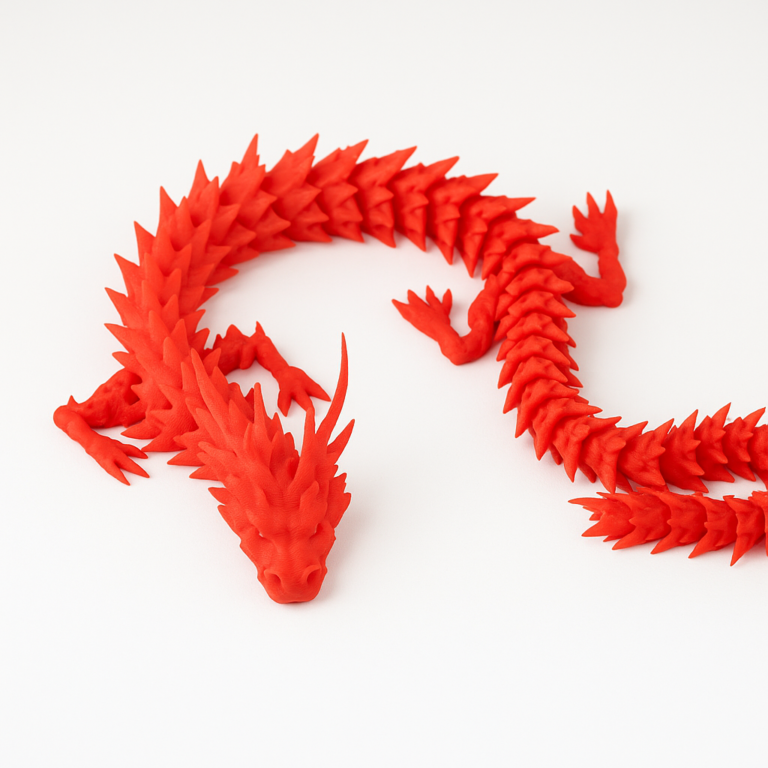
The Flexi Dragon and Skeleton Diplodocus illustrate two very different silhouettes. Use the photographs to inspect the connections, projecting details and overall footprint. A coiled display position may use less desk space than an extended position, but you need the actual dimensions to judge fit.
For a dragon, look at how the body segments relate to the head and tail. For a skeleton-style model, look at the exposed ribs and other narrow details before deciding how it will be handled or transported. These observations are selection prompts, not claims that one product has been tested as stronger than the other.
Four questions to ask before choosing
- Where will it live? Measure the display area and think about the model’s position while being handled, not only while resting.
- How will it be used? Occasional posing, regular desk handling and carrying it loose in a bag are different demands.
- Who will have access? Check the item’s safety information and consider small parts, projecting details, children and pets.
- What must be confirmed? Ask about dimensions, included pieces, material or movement if the listing does not answer an important question.
If you are selecting a gift, those questions are more useful than choosing only by color. Someone with a crowded shared desk may value a compact resting position; a collector with a display shelf may care more about the silhouette. Neither preference requires assuming a health benefit.
A gentle first-use check
Open the packaging over a clear surface. Lift the model by its main body or supported base, not an extended limb or horn. Look for transport damage before moving it. Keep packaging and any loose pieces away from children and pets while you check what was supplied.
Support neighboring segments and explore a small amount of movement at one connection at a time. Stop at resistance rather than searching for the maximum possible angle. Do not repeatedly twist a joint to “break it in,” pull the ends in opposite directions or use a tool to pry a connection open.
If something appears stuck, photograph the joint from two angles and ask for guidance. Explain whether it arrived that way or changed after use. This gives the workshop a chance to distinguish an obstruction, damage or a misunderstanding of the intended motion without further stressing the part.
Read surface texture separately from damage
Fine lines on a filament print can reflect the layered manufacturing process. A regular pattern alone is not the same as a separating crack. Look for a sudden change: an opening that was not there, a piece that has become loose or a sharp edge after an impact.
A useful message includes the whole item for orientation, a close-up showing the concern and the original product link. Avoid making a video that repeatedly forces the suspect area simply to show it moving. Set the item aside if it is damaged and keep detached pieces safely contained.
Ask before changing size or adding a name
Reducing an articulated model does more than make it shorter: fine details, connections and spaces between parts also change. Enlarging it changes how much room it takes to move and display. A request for a different size therefore needs a design review, not just a new number on the order.
If you want a name, identify where it should be read and whether a separate base would work. Text placed across moving segments may create a different problem from text on a stationary stand. Use our custom-print planning guide to explain the purpose, maximum dimensions and priorities.
Keep the model enjoyable by keeping its limits clear
Give it a stable home, protect fine details during transport and use the PLA care guide when that is the material identified in the listing. Do not use an articulated desk model as a chew toy, safety device or load-bearing part. An appealing moving design is not evidence of certification for those uses.
For product-specific questions, use Contact Us before ordering or forcing a part that seems wrong. The best choice is the model whose size, intended use and handling requirements suit the real space and person it is being chosen for.